

Table of Contents
- Key Points
- What Is Squamous Cell Carcinoma?
- Is Squamous Cell Carcinoma a Serious Cancer?
- Common Risk Factors
- Squamous Cell Carcinoma Warning Signs
- How Squamous Cell Carcinoma Is Diagnosed and Treated
- Schedule a Skin Cancer Screening
- Frequently Asked Questions
- References
Key Points
- Squamous cell carcinoma is highly treatable when caught early, with survival rates above 99 percent, but outcomes decline significantly once the cancer spreads beyond the skin.1
- Cumulative sun exposure is the leading cause of squamous cell carcinoma, and daily sunscreen use can significantly lower a person’s risk.
- Because South Carolina’s climate means almost year-round UV exposure, routine skin checks with a dermatologist in Greenville are one of the most effective ways to catch this cancer early.
Every hour, physicians across the United States diagnose an estimated 205 new cases of squamous cell carcinoma, adding up to roughly 1.8 million cases each year. That makes it the second most common form of skin cancer in the country, trailing only basal cell carcinoma.2
Despite how frequently it occurs, many patients have never heard of squamous cell carcinoma, and even fewer understand how serious it can become if it is left unchecked. At Rogers Dermatology, we believe informed patients make better decisions about their skin health, so this article explains what squamous cell carcinoma is, how it develops, and what to do if you notice a suspicious spot.
What Is Squamous Cell Carcinoma?
Squamous cell carcinoma (SCC) develops in the squamous cells that make up the outer layers of the skin, known as the epidermis. These flat cells are constantly shedding and regenerating as part of the skin’s normal cycle. When ultraviolet (UV) radiation or other damaging exposures cause mutations in a squamous cell’s DNA, that cell can begin to divide uncontrollably, forming a tumor. Unlike basal cell carcinoma, which tends to grow slowly and stay localized, squamous cell carcinoma has a somewhat greater tendency to invade deeper tissue and, in a minority of cases, spread to lymph nodes or distant organs.3
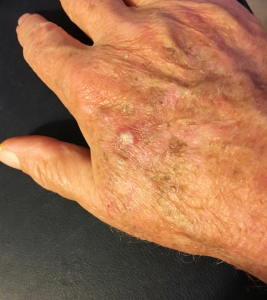
SCC most often appears on skin that receives frequent sun exposure, including the face, ears, neck, lips, back of the hands, and scalp. It can look like a firm red bump, a scaly patch, a sore that heals and then reopens, or a wart-like growth. Because these changes can be subtle, many patients mistake early SCC for a stubborn pimple, eczema patch, or minor injury.
Is Squamous Cell Carcinoma a Serious Cancer?
On some level, all cancers are serious. How dangerous squamous cell carcinoma is depends almost entirely on timing. As mentioned, when it is identified while still confined to the skin, the five-year survival rate is greater than 99 percent, and most cases are cured with a single, relatively minor procedure.
However, if the cancer is allowed to grow unchecked and eventually spreads beyond the epidermis into deeper tissue, lymph nodes, or other organs, the five-year survival rate falls to approximately 50 percent. Each year, an estimated 40,000 cases in the United States progress to this more advanced, harder-to-treat stage.4
This gap between early and late outcomes is the central reason dermatologists emphasize regular skin exams. Squamous cell carcinoma is rarely an emergency in its early stages, but it is also not something to ignore. A lesion that persists for more than a few weeks, changes in size or texture, or fails to heal warrants a professional evaluation.
Common Risk Factors
Certain factors substantially increase a person’s likelihood of developing squamous cell carcinoma. Understanding these can help patients prevent it and determine how much at risk they might be.
- Cumulative sun exposure: Years of UV exposure is the primary driver behind most cases.
- Fair skin, light eyes, or red or blonde hair: These traits are associated with less natural pigment protection against UV damage.
- A history of indoor tanning: Research indicates that people who have used a tanning bed have a much higher risk of developing any type of skin cancer.5
- Age over 50: Because SCC often results from decades of sun exposure, incidence rises steadily with age (though dermatologists are seeing more cases in younger adults as well).
- A weakened immune system: Organ transplant recipients, who take immunosuppressive medication, are roughly 100 times more likely than the general public to develop this cancer.6
- A personal history of actinic keratosis: These rough, scaly patches are considered precancerous and can progress to squamous cell carcinoma if left untreated.
- Occupational or chronic skin injury: Long-standing scars, burns, or chronic wounds are less common but recognized risk sites.
Squamous Cell Carcinoma Warning Signs
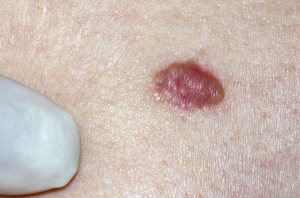
Because squamous cell carcinoma can resemble other, more benign skin conditions, patients are encouraged to schedule an evaluation if they notice any of the following:
- A firm, red or skin-colored bump that continues to grow
- A flat, scaly patch that feels rough or crusty to the touch
- A sore that bleeds, crusts over, and then reopens rather than fully healing
- A wart-like growth, particularly on sun-exposed skin
- A raised mole or ulcer that develops within an existing scar
- Any new or changing spot that does not resolve within four to six weeks
How Squamous Cell Carcinoma Is Diagnosed and Treated
If a dermatologist identifies a suspicious lesion, the next step is typically a skin biopsy, in which a small tissue sample is removed and examined under a microscope. This confirms the diagnosis and helps determine how deeply the skin cancer has grown, which guides the treatment plan.
Common treatment approaches include:
- Excisional surgery, in which the growth and a margin of healthy tissue are surgically removed
- Mohs micrographic surgery, a precise, layer-by-layer technique often used for lesions on the face or areas where preserving healthy tissue is a priority
- Curettage and electrodesiccation, which scrapes away the tumor and uses an electric current to destroy remaining cancer cells, typically for smaller, lower-risk lesions
- Radiation therapy, generally reserved for cases where surgery is not an option
- Topical or systemic medications, which may be used for very early lesions or advanced disease, depending on the case
The right approach depends on the tumor’s size, depth, and location, along with the patient’s overall health. That is why an individualized evaluation matters more than any general rule of thumb.
Schedule a Skin Cancer Screening
Squamous cell carcinoma is common, but it is also one of the more preventable and treatable cancers when patients stay proactive about their skin health. If you are searching for a dermatologist in Greenville, look for a board-certified provider who offers full-body skin exams, biopsy services, and a range of treatment options on-site.
Rogers Dermatology has built its reputation by combining thorough skin exams with treatment plans tailored to each patient’s specific diagnosis and risk profile. Whether you have noticed a new or changing spot or simply have not had a skin check in the past year, our team is here to help you take a proactive approach to your skin health. Contact us today to schedule an appointment.
Frequently Asked Questions
Is squamous cell carcinoma a serious cancer?
It can be, but the outlook depends heavily on when it is caught. Squamous cell carcinoma detected and treated early has a five-year survival rate above 99 percent, while cases that spread beyond the skin have a significantly lower survival rate. This is why prompt evaluation of any suspicious lesion is so important.
How quickly does squamous cell carcinoma grow?
Growth rates vary from patient to patient, but SCC generally develops over weeks to months rather than days. Some lesions grow slowly for a long period before becoming more aggressive, which is part of why a lesion that persists or changes should always be evaluated rather than assumed to be harmless.
Can squamous cell carcinoma be cured?
Yes, in the vast majority of cases. When identified while still confined to the skin, SCC is typically cured through a single outpatient procedure, such as excision or Mohs surgery.
Is squamous cell carcinoma the same as melanoma?
No, squamous cell carcinoma and melanoma are different types of skin cancer that arise from different cells. Melanoma develops from pigment-producing melanocytes and is generally more aggressive, while SCC develops from squamous cells and is more common but typically less dangerous, when caught early.
How often should I get a skin cancer screening?
We recommend an annual full-body skin exam for the general population, with more frequent checks for patients who have a significant sun exposure history, a prior skin cancer diagnosis, or a weakened immune system.
References
- Stephanie Watson, “Prognosis and Outlook for Stage 4 Squamous Cell Carcinoma,” Healthline.com, February 2020, https://www.healthline.com/health/stage-4-squamous-cell-carcinoma-prognosis-and-outlook.
- “Have You Heard of Cutaneous Squamous Cell Carcinoma?” Skin Cancer Foundation, September 2023, https://www.skincancer.org/blog/have-you-heard-of-cutaneous-squamous-cell-carcinoma/.
- Mayo Clinic Staff, “Squamous cell carcinoma of the skin,” Mayo Clinic, July 2025, https://www.mayoclinic.org/diseases-conditions/squamous-cell-carcinoma/symptoms-causes/syc-20352480.
- Stefanie Remson, “Stages of squamous cell carcinoma and prognosis,” Medical News Today, March 2025, https://www.medicalnewstoday.com/articles/stages-of-squamous-cell-carcinoma.
- Mingfeng Zhang, Abrar A. Qureshi, Alan C. Geller, et al., “Use of Tanning Beds and Incidence of Skin Cancer,” Journal of Clinical Oncology, February 2012, https://pmc.ncbi.nlm.nih.gov/articles/PMC3383111/.
- Sophie Li, Thomas Townwa, AND Shorook Na’ara, “Current Advances and Challenges in the Management of Cutaneous Squamous Cell Carcinoma in Immunosuppressed Patients,” Cancers, September 2024, https://pubmed.ncbi.nlm.nih.gov/39335091/.