

Table of Contents
- Key Points
- What Is Melanoma?
- What Makes Melanoma Distinct?
- Risk Factors: Identifying Your Susceptibility
- The ABCDEs of Melanoma Detection
- Prevention is Key: Protecting Your Skin Every Day
- The Importance of Regular Skin Self-Exams
- How Is Melanoma Treated?
- Living with Melanoma: Support and Resources
- Our Commitment to Your Skin Health
- References
Key Points
- Almost 150,000 cases of melanoma are diagnosed in the United States every year.1
- Melanoma is the most dangerous type of skin cancer.
- According to the Cleveland Clinic, in cases where melanoma is caught in its earlier stage, there is a 99 percent cure rate,2 a statistic that emphasizes the importance of self-evaluations, professional screenings, and knowledge about the condition.
Skin cancer. The words themselves prompt unease, even panic. Among the various types of skin cancer, melanoma often stands out due to its potential for aggressive growth and spread. According to the American Cancer Society, while melanoma accounts for only about 1 percent of skin cancers, it is responsible for a large majority of skin cancer deaths.3
That’s the bad news. The good news is that early detection results in very promising health outcomes.
At Rogers Dermatology, we believe in empowering our patients with the information they need to protect their skin. This comprehensive guide delves into everything you need to know about skin melanoma, from its origins to prevention strategies and the importance of regular skin evaluations. With knowledge, vigilance, and proactive care, you can significantly reduce your risk.
What Is Melanoma?
Melanoma is a type of skin cancer that develops in melanocytes, the cells responsible for producing melanin, the pigment that gives human skin its color.4 While most melanocytes are found in the skin, they can also occur in other parts of the body, such as the eyes and, sometimes, internal organs.
Unlike basal cell carcinoma and squamous cell carcinoma—the other common types of skin cancer—melanoma has a higher propensity to metastasize, meaning it can spread to other parts of the body, including lymph nodes and internal organs. This characteristic makes early detection and treatment crucial for successful management—including of malignant melanoma.
What Makes Melanoma Distinct?
Several factors distinguish melanoma from other skin cancers:
- Origin: As mentioned, melanoma originates in melanocytes, while basal and squamous cell carcinomas arise from keratinocytes, the main type of skin cell.
- Appearance: Melanomas can vary greatly in appearance, often exhibiting irregular borders, uneven color, and asymmetry. While some melanoma cancers may arise from existing moles, others can appear as new spots on the skin.
- Growth Pattern: Melanomas can grow both horizontally (superficially) and vertically (deeper into the skin). Vertical growth increases the risk of metastasis.
- Metastatic Potential: Melanoma has a significantly higher risk of spreading to distant sites compared to basal and squamous cell carcinomas. According to research published last year, it is the fifth most common malignancy in both males and females.5
Risk Factors: Identifying Your Susceptibility
While melanoma can affect anyone, certain factors increase your risk. Understanding these is the first step toward proactive prevention:
- Sun Exposure: Excessive exposure to ultraviolet (UV) radiation from the sun and tanning beds is the most significant preventable risk factor for all types of skin cancer, including melanoma.6 Intermittent, intense sun exposure, especially sunburns during childhood and adolescence, appears to play a crucial role in melanoma development.
- Moles: Having a large number of moles (more than 50 common moles or one or more atypical moles) increases the risk of melanoma. Atypical moles, also known as dysplastic nevi, are larger than common moles and have irregular shapes and borders.7
- Family History: A personal or family history of melanoma significantly elevates your risk. If a close relative (parent, sibling, or child) has had melanoma, your risk is higher, since it could suggest a genetic predisposition.
- Fair Skin, Freckling Tendency, Light Hair and Eyes: Individuals with less melanin in their skin are more susceptible to UV damage, and therefore have a higher risk of melanoma.
- Weakened Immune System: People with compromised immune systems due to organ transplantation, HIV/AIDS, or certain medical treatments are at an increased risk of melanoma.
- Previous Skin Cancer: A history of any type of skin cancer, including basal cell carcinoma or squamous cell carcinoma, increases your risk of developing melanoma.
- Age: While melanoma can occur at any age, the risk increases as you get older.
- Xeroderma Pigmentosum: This rare inherited condition causes extreme sensitivity to UV radiation and dramatically increases the risk of skin cancers, including melanoma.8
The ABCDEs of Melanoma Detection
Early detection is paramount in improving the prognosis of melanoma. Familiarizing yourself with the “ABCDEs” can help you identify suspicious moles or skin changes that warrant a dermatologist’s attention: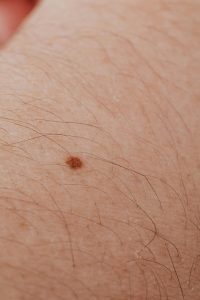
- A – Asymmetry: One half of the mole does not match the other half. Benign moles are typically symmetrical.
- B – Border Irregularity: The edges of the mole are ragged, notched, blurred, or uneven. Benign moles usually have smooth, well-defined borders.
- C – Color Variation: The mole has multiple colors, such as shades of brown, black, red, white, or blue. Benign moles are usually a single, uniform color.
- D – Diameter: The mole is larger than 6 millimeters (about the size of a pencil eraser). While smaller melanomas exist, a larger diameter can be a warning sign.
- E – Evolving: The mole is changing in size, shape, color, or elevation, or is developing new symptoms like bleeding, itching, or crusting. Any change in a mole should be evaluated by an experienced dermatologist.
While the key above can be a helpful guide to the most prominent melanoma symptoms, it is important to be aware of other potential signs. These include:
- A new mole, spot, or bump that looks different from your other moles.
- A sore that will not heal.
- Redness or swelling beyond the border of a mole.
- A change in sensation, such as itching, tenderness, or pain, in a mole.
- A scaly, flaky, or oozing area on the skin.
If you detect any of the above, you should schedule an appointment with a dermatologist for a professional assessment.
Prevention is Key: Protecting Your Skin Every Day
While not all melanomas are preventable, one of the easiest yet best things you can do to reduce your risk is to adopt sun-safe habits. The key is employing these protections every day, so that the avoidance of sun damage becomes cumulative over the years.
- Seek Shade: Especially during peak UV radiation hours (typically between 10 a.m. and 4 p.m.).

- Wear Protective Clothing: Opt for tightly woven fabrics, wide-brimmed hats, and UV-protective sunglasses.
- Use Sunscreen Regularly: Apply a broad-spectrum sunscreen to all exposed skin, even on cloudy days. Studies show that regular use of SPF 15 or higher sunscreen reduces the risk of developing melanoma by 50 percent (though most dermatologists recommend an SPF of 30 or higher).9 Reapply every two hours, or immediately after swimming or sweating.
- Avoid Tanning Beds and Sunlamps: These artificial sources of UV radiation are just as harmful as the sun.
- Be Extra Cautious Near Water, Snow, and Sand: These surfaces reflect and intensify UV rays.
- Protect Children: Children’s skin is more sensitive to sun damage. Establish sun-safe habits early in life.
The Importance of Regular Skin Self-Exams and Professional Skin Checks
Becoming familiar with your skin and performing regular self-exams is crucial for early detection. Examine all areas of your body, including your scalp, ears, palms, soles, and between your toes. Use a mirror to check hard-to-see areas.
In addition to self-exams, regular professional screenings by a dermatologist are essential, especially if you have risk factors for melanoma. During these, your dermatologist will carefully examine your entire skin surface, looking for any suspicious moles or lesions. They may use a dermatoscope, a handheld magnifying device with a light source, to get a closer look at moles.
If a suspicious mole or lesion is identified, your dermatologist will likely perform a biopsy. This involves removing a small sample of the skin for microscopic examination by a pathologist to determine if melanoma cells are present.
How Is Melanoma Treated?
If melanoma is diagnosed, the stage of the cancer will be determined based on factors such as the thickness of the melanoma, the presence of ulceration, the rate of cell division (mitotic rate), and whether it has spread to lymph nodes or distant sites.
Treatment options for melanoma vary depending on the stage and location of the cancer and may include:
- Surgical Excision: This is the primary treatment for early-stage melanoma, involving the surgical removal of the melanoma and a surrounding margin of normal skin.
- Sentinel Lymph Node Biopsy: For melanomas with a higher risk of spread, this procedure involves identifying and removing the first lymph node(s) to which the melanoma cells are likely to travel. If melanoma cells are found in the sentinel lymph node, it indicates that the cancer has begun to spread.
- Lymph Node Dissection: If melanoma cells are found in the sentinel lymph node or if there is clinical evidence of lymph node involvement, a more extensive removal of lymph nodes in the affected area may be necessary.
- Radiation Therapy: This treatment uses high-energy rays to kill cancer cells. It may be used for melanomas that cannot be surgically removed, for local recurrences, or to treat melanoma that has spread to lymph nodes or other areas.
- Chemotherapy: This treatment uses drugs to kill cancer cells throughout the body. It is typically used for advanced melanoma that has spread to distant organs.
- Targeted Therapy: Certain drugs can be used to target specific molecules involved in the growth and spread of melanoma cells. They are effective for melanomas with certain genetic mutations.
- Immunotherapy: These drugs help your body’s immune system recognize and attack cancer cells. Immunotherapy has shown significant promise in treating advanced melanoma.
Living with Melanoma: Support and Resources
A melanoma diagnosis can be challenging, but remember that you are not alone. Many resources and support systems are available to help you navigate your journey.
Your dermatologist and oncology team will provide you with comprehensive care and guidance. You may also find support groups, online communities, and patient advocacy organizations helpful.
Our Commitment to Your Skin Health
Protecting your skin is an investment in your long-term health. By understanding the risks, practicing sun-safe habits, and being vigilant about skin changes, you can significantly reduce your risk of melanoma, and ensure early detection and treatment, if necessary.
At Rogers Dermatology, we are dedicated to providing comprehensive skin care, including melanoma prevention, early detection, and management. Our experienced dermatologists are here to answer your questions, perform thorough skin exams, and develop personalized treatment plans. We encourage you to schedule regular skin examinations and to contact us immediately if you notice any suspicious changes on your skin.
References
- “Key Statistics for Melanoma Skin Cancer,” American Cancer Society, January 2025, https://www.cancer.org/cancer/types/melanoma-skin-cancer/about/key-statistics.html.
- “Melanoma,” Cleveland Clinic, June 2021, https://my.clevelandclinic.org/health/diseases/14391-melanoma.
- “Key Statistics for Melanoma Skin Cancer,” January 2025.
- Mayo Clinic Staff, “Melanoma,” Mayo Clinic, December 2023, https://www.mayoclinic.org/diseases-conditions/melanoma/symptoms-causes/syc-20374884.
- Srinath Sundararajan, Aye M. Thida, Sujitha Yadlapati, Shiva Kumar R. Mukkamalla, and Supriya Koya, “Metastatic Melanoma,” StatPearls Publishing, https://www.ncbi.nlm.nih.gov/books/NBK470358/.
- “Health Effects of UV Radiation,” U.S. Environmental Protection Agency, February 2025, https://www.epa.gov/sunsafety/health-effects-uv-radiation.
- “Common Moles, Dysplastic Nevi, and Risk of Melanoma,” National Cancer Institute, November 2022, https://www.cancer.gov/types/skin/moles-fact-sheet.
- “Xeroderma Pigmentosum,” National Organization for Rare Diseases, February 2025, https://rarediseases.org/rare-diseases/xeroderma-pigmentosum/.