

Table of Contents
- Key Points
- What Is Psoriasis?
- Common Types of Psoriasis
- Recognizing Psoriasis Symptoms
- What Triggers a Psoriasis Flare?
- The Link Between Psoriasis and Psoriatic Arthritis
- How Dermatologists Diagnose Psoriasis
- Treatment Options for Psoriasis
- Everyday Habits That Support Treatment
- Schedule a Psoriasis Evaluation With a Dermatologist in Greenville
- Frequently Asked Questions
- References
Key Points
- Psoriasis is a chronic, immune-mediated skin disease that affects millions of American adults and tends to cycle between flares and calmer periods.
- Plaque psoriasis is the most common form, but several other types exist, and some people also develop psoriatic arthritis, which affects the joints.
- A qualified dermatologist can confirm the diagnosis, help identify likely triggers, and build a psoriasis treatment plan suited to the type and severity of the condition.
Psoriasis is far more common than many people realize. Roughly 3 percent of U.S. adults, or more than 7.5 million people, live with psoriasis.1
Despite how common it is, psoriasis is frequently misunderstood. It is sometimes mistaken for a simple rash, dismissed as a cosmetic concern, or wrongly assumed to be contagious. In reality, it is a chronic disease of the immune system that can affect the skin, scalp, nails, and, for some people, the joints.
Understanding how psoriasis works, what tends to make it worse, and which treatments are available is the first step toward relief. Keep reading to learn more.
What Is Psoriasis?
Psoriasis is what clinicians call an “immune-mediated” disease, meaning the immune system itself drives the symptoms. In people with psoriasis, certain immune cells become overactive and release signals that cause skin cells to multiply far faster than normal. Instead of shedding gradually, the excess cells accumulate on the surface of the skin, forming the thick, scaly patches.
Researchers have not identified a single cause. Genetics plays a clear role, since psoriasis tends to run in families, yet not everyone who inherits a predisposition develops the disease. Environmental factors, such as infections, certain medications, smoking, and excess weight, appear to activate the condition in people who are already susceptible.2
Increasingly, psoriasis is understood as more than a skin condition. People with psoriasis face a higher risk of several other health concerns, including heart attack and stroke, diabetes, metabolic syndrome, and mental health challenges such as anxiety and depression.3 For that reason, managing psoriasis well is about overall health as much as it is about the appearance of the skin.
Common Types of Psoriasis
Psoriasis takes several forms, and a person may have more than one type at once or shift from one type to another over time. The main types include:
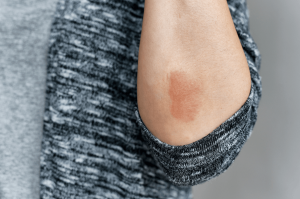
- Plaque psoriasis: The most common form, plaque psoriasis causes raised, inflamed patches covered with silvery-white scale, usually on the elbows, knees, scalp, and lower back.
- Guttate psoriasis: Small, drop-shaped spots that often appear on the torso and limbs, most commonly in children and young adults, and frequently following strep throat or another upper respiratory infection.
- Inverse psoriasis: Smooth, inflamed patches in skin folds such as the armpits, groin, and beneath the breasts, where friction and sweat tend to aggravate symptoms.
- Pustular psoriasis: Bumps filled with pus (which is not infectious) surrounded by reddened skin, most often on the hands and feet.
- Erythrodermic psoriasis: A rare but serious form that causes widespread redness and peeling across most of the body and requires prompt medical attention.4
Psoriasis can also involve the scalp and nails, either on its own or alongside patches elsewhere on the body.
Recognizing Psoriasis Symptoms
Symptoms vary considerably from one person to the next, including level of severity, but common signs include:
- Scaly patches: Thick, raised areas of skin with silvery-white scales (on darker skin tones, patches may appear purple, gray, or dark brown rather than red).
- Itching or burning: Discomfort that can range from mild to intense and may interfere with sleep.
- Dry, cracked skin: Skin that splits or bleeds, particularly over the knuckles, elbows, and knees.
- Nail changes: Small pits, ridges, discoloration, or thickening of the fingernails or toenails.
- Scalp involvement: Flaking that can resemble stubborn dandruff but is typically thicker and more sharply defined.
These symptoms often follow a cycle, flaring for weeks or months before quieting down or even clearing for a time. Those flares rarely come out of nowhere—in many cases, something identifiable sets them off.
What Triggers a Psoriasis Flare?
Triggers differ from person to person, and identifying your own can be one of the more useful steps in managing the condition. Common ones include:
- Stress: Periods of emotional or physical strain are among the most frequently cited triggers.
- Skin injury: Cuts, scrapes, sunburns, and even tattoos can prompt new patches to form at the site of the injury, a response known as the “Koebner phenomenon.”
- Infections: Strep throat, in particular, is closely associated with guttate psoriasis.
- Certain medications: Lithium, some heart and blood pressure medications, and certain antimalarial drugs may provoke or worsen symptoms in some people.
- Cold, dry weather: Many people notice flares in the winter months, when humidity drops and sun exposure decreases.
- Smoking and heavy drinking: Both are associated with more frequent or more severe flares.
Because one person’s trigger may have no effect on someone else, paying attention to personal patterns tends to be more helpful than avoiding every possible trigger at once.5 If you suspect a prescribed medication is contributing to flares, it is important to talk with the prescribing provider before making any changes.
The Link Between Psoriasis and Psoriatic Arthritis
For some people, psoriasis is not limited to the skin. About 30 percent of people with psoriasis develop psoriatic arthritis, an inflammatory form of arthritis that affects the joints and the points where tendons and ligaments attach to bone.6 The two conditions do not always appear in a predictable order—joint symptoms most often follow skin symptoms, but some people develop psoriatic arthritis first.
Early recognition matters, because untreated psoriatic arthritis can lead to lasting joint damage. Warning signs worth reporting to a healthcare provider include:
- Joint pain or stiffness: Pain, swelling, tenderness, or stiffness in one or more joints.
- Warm or red joints: Joints that feel warm to the touch or appear red.
- Swollen fingers or toes: Swelling of an entire finger or toe that gives it a “sausage-like” appearance.
- Foot and ankle pain: Discomfort in and around the feet and ankles, including the heel.
- Lower back pain: Pain in the lower back, just above the tailbone.
- Nail changes: Pitting or separation of the nail from the nail bed, which can accompany joint involvement.
How Dermatologists Diagnose Psoriasis
In most cases, a qualified dermatologist can diagnose psoriasis through a careful examination of the skin, scalp, and nails, combined with questions about symptoms, family history, recent illnesses, and current medications. Because several other conditions can resemble psoriasis (including eczema, fungal infections, and seborrheic dermatitis), a small skin sample, or “biopsy,” is occasionally taken to confirm the diagnosis.
The evaluation also establishes which type of psoriasis is present and how much of the body it affects. Both factors play a central role in deciding which treatments are appropriate.
Treatment Options for Psoriasis
There is currently no cure for psoriasis, but treatment can often substantially reduce symptoms, lengthen the time between flares, and improve quality of life. Dermatologists typically match treatment to the type, location, and severity of the disease. The main categories of treatment include:
- Topical medications: Creams, ointments, foams, and solutions applied directly to the skin, such as corticosteroids and synthetic forms of vitamin D, which are often the first approach for limited psoriasis.
- Phototherapy: Carefully controlled exposure to ultraviolet light under medical supervision, which can slow the overgrowth of skin cells when topical treatment alone is not enough.
- Oral medications: Pills that work throughout the body, generally considered for more extensive psoriasis or cases that have not responded to other approaches.
- Biologics: Injected or infused medications that target specific parts of the immune system and are an important option for moderate to severe psoriasis, psoriatic arthritis, or both.
Many treatment plans combine more than one approach, and adjustments over time are common. A treatment that works well at one stage may need to be revisited later as symptoms, health needs, or life circumstances change.
Everyday Habits That Support Treatment
Medical treatment tends to work best alongside consistent self-care at home. A few habits that may help include:
- Moisturize daily: Thick, fragrance-free creams or ointments can reduce dryness, scaling, and itching, especially when applied right after bathing.
- Keep baths and showers short: Lukewarm water and gentle cleansers are less likely to strip the skin than long, hot soaks.
- Track your flares: A simple record of flares, stress levels, illnesses, and weather can reveal personal patterns worth discussing with your dermatologist.
- Avoid picking or scratching: Removing scale by force can injure the skin and, because of the Koebner phenomenon, may lead to new patches.
- Limit alcohol and avoid smoking: Both are linked to flares, and reducing them may support better control of symptoms.
- Take medications as directed: Stopping a prescribed treatment abruptly can sometimes cause symptoms to rebound, so it is best to discuss any changes with your dermatologist first.
Schedule a Psoriasis Evaluation With a Dermatologist in Greenville
At Rogers Dermatology, we evaluate and treat psoriasis for patients throughout the Upstate. If you have scaly patches that have not improved with over-the-counter care, notice changes in your nails, or are experiencing joint pain alongside skin symptoms, an appointment with a dermatologist in Greenville can help clarify what is happening and which options make sense for you.
Whether you are seeking help for the first time or looking for a Greenville, SC, dermatologist to help manage a long-standing diagnosis, we can review your symptoms, discuss likely triggers, and talk through treatment options suited to your situation. We invite you to contact our office to schedule an appointment and take the next step in managing your psoriasis.
Frequently Asked Questions
Is psoriasis contagious?
Psoriasis is not contagious. It is an immune-mediated condition rather than an infection, so it cannot spread through touch, shared towels, swimming pools, or any other form of contact.
Can psoriasis go away on its own?
Not usually—at least not permanently. Psoriasis is a chronic condition, but its symptoms often come and go, and some people experience extended periods of remission, when the skin clears partially or completely. Treatment can help make those calmer periods more frequent and longer-lasting.
How is psoriasis different from eczema?
Both conditions cause itchy, inflamed skin, which is why they are easily confused. Psoriasis patches tend to be thicker, more sharply defined, and covered with silvery scale, and they commonly appear on the elbows, knees, and scalp. Eczema more often affects the inner elbows and the backs of the knees and is typically intensely itchy. Because the two can overlap in appearance, an examination by a dermatologist is the most reliable way to tell them apart.
Does a dermatologist treat psoriatic arthritis?
In most cases, yes. Psoriatic arthritis may be managed by a rheumatologist, or at least in coordination with your dermatologist. Some treatments, including certain biologics, address both the skin and the joints, which makes communication between specialists especially valuable.
References
- April W. Armstrong, Manan D. Mehta, Clayton W. Schupp, et al., “Psoriasis Prevalence in Adults in the United States,” JAMA Dermatology, August 2021, https://pmc.ncbi.nlm.nih.gov/articles/PMC8246333/
- Mayo Clinic Staff, “Psoriasis: Symptoms and causes,” Mayo Clinic, December 2025, https://www.mayoclinic.org/diseases-conditions/psoriasis/symptoms-causes/syc-20355840.
- “Psoriasis,” National Institute of Arthritis and Musculoskeletal and Skin Diseases, October 2023, https://www.niams.nih.gov/health-topics/psoriasis.
- “Types of Psoriasis,” National Psoriasis Foundation, June 2025, https://www.psoriasis.org/locations-and-types/.
- “Are You at Risk for Psoriatic Arthritis?” National Psoriasis Foundation, December 2022, https://www.psoriasis.org/risk-for-psoriatic-arthritis/.
- “Understanding Arthritis: Psoriatic Arthritis,” Arthritis National Research Foundation, retrieved on October 20, 2026, from: https://curearthritis.org/psoriatic-arthritis/.